

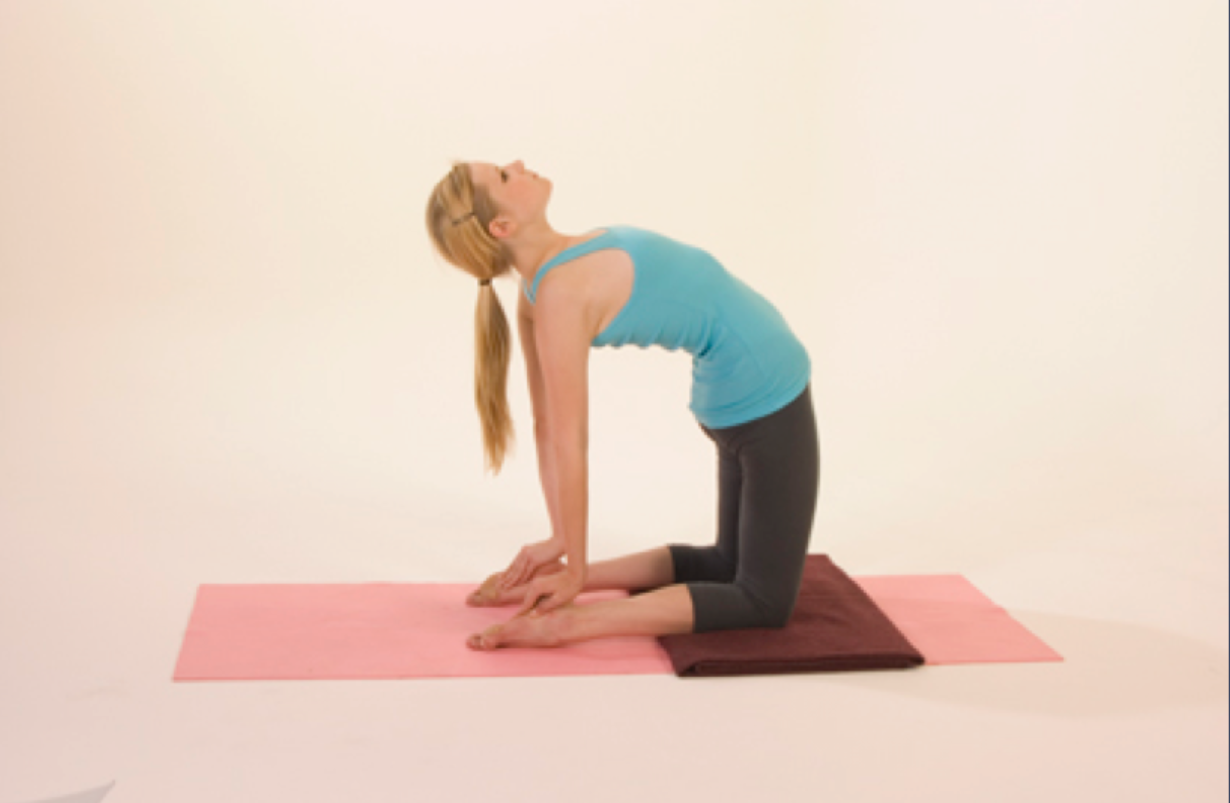
Ustrasana

Pronunciation: (oosh-TRAHS-ahna)
Translation: Ustra means Camel. Asana means yoga pose or posture.
Technique: Begin seated on the heels, kneeling on the floor with your heels slightly apart and thighs perpendicular to the floor. Some practitioners put the thighs together which is a more advanced way of working this pose. Others place a block, on its end with the approximate 3 inch width between the thighs during the pose. Lift your pelvis up to vertical with your upper legs perpendicular to the floor. Plant your shins and tops of your feet to the floor. With your pelvis stable, extend your spine by lifting your sternum toward the sky. This will create length between your vertebrae which is crucial. This will help you do the pose comfortably, and is especially important to do in your neck and lower back as these are sensitive areas. Maintaining length, push the pelvis forward as you place your hands on your lower back with fingers pointing up. Bend backwards while exhaling slowly.
Your eyes should notice a spot ahead of you and focus, then moving to a spot above you as you bend your head moves back. Dristi is the practice of focusing on a point with your visual awareness, helps you to do the pose more easily, and is very important. Breathe slow and deep in a relaxed way. Your neck should be long and extended, not crunching. It is best to take the bending backwards slowly and only go as far as you are comfortable. As you make your pelvis stable and bring it forward, imagine yourself bring the tailbone forward toward the pubis. This keeps your lower back long with space between vertebrae and helps prevent hurting your back in the process. Your shoulder blades are rolled inwards to open up the muscles of the chest.
If you feel comfortable at this level of the pose, then you can go deeper. To do so, extend your arms one by one and press your palms against your heels with the fingers pointing toward the toes. Start with one hand and then place the other hand on your heel. Transfer your weight and support to the hands.
If the posture is viewed from the side, the hips extend further forward than any other part of the body. Imagine that you are reaching toward someone’s hands which are placed on your hipbones. Press forward into those hands again without losing the lift and separation in the vertebrae of the lumbar spine in the lower back and in the neck. Think of elongating and lengthening the spine, especially in these areas. Are you remembering to press the shins down into the floor as roots?
Focus on your point in front of you or on the ceiling depending on how your neck is doing, extending it back no further than it is willing. Keep the ujaii breaths flowing freely as you keep your dristi focal point. Send your breath inside your body to any places that feel stuck. Notice the stiff places and try to melt them with softness using your awareness and breath. Yoga is about developing this inner awareness of your body.
To finish, put your hands on your hip bones. As you breathe in, lead with your heart and lift the head upright as you push the hipbones down toward your heels, bending at the knee. You may enjoy resting in Child’s Pose after this intense backbend.
Tips for Beginners:
1. If you are learning this pose, you may not be able to go to the second level and reach your heels. If it is comfortable for your feet, turn your toes under and raise your heels, and then reach for them one by one.
2. Another variation, if this isn’t easy is to use two blocks standing on end. Rest each hand on a block with the blocks positioned outside your heels.
3. Another option is a variation with a chair. A folding chair works well. Kneel for the pose with your back to the chair’s front, with your calves and feet below the seat. Put the chair at your lower back. Next, lean back and place your hands to the sides of the seat or higher up on the chair legs.
4. Do the pose facing the wall with your hips close to the wall. Try to make your hips touch the wall as you are in the pose. The wall may help you feel secure as you go backwards into the pose.