

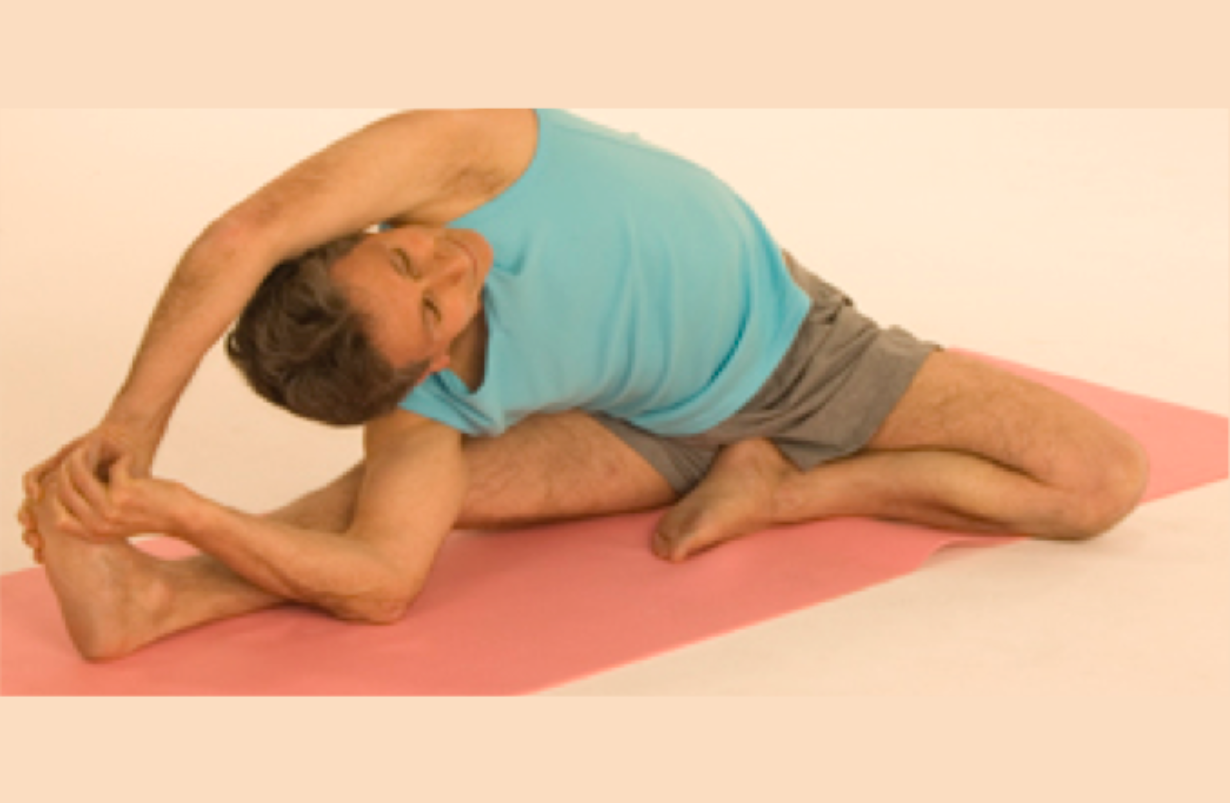
Parivrtta Janusirsasana

Translation:
In Sanskrit, Parivrtta means to turn around or revolved. Janu means knee and sirsa means head. Asana means pose in Sanskrit. Thus Parivrtta Janu Sirsasana is the Revolved Head-Knee Pose.
This is a seated forward bending posture which is also a twist as the extended torso revolves and descends over an extended leg. In the final pose, the back of the head rests on the leg with the torso facing as far upwards as possible. Eventually, the final pose has the torso so revolved that the navel faces directly upwards. In the pose the hips open and there is an intense stretch in the side body. The heart also opens in this posture and you may notice the flowing of emotion when this posture is practiced.
Move slowly and carefully into this posture. It is an extremely powerful and intense stretch for the body. Bring your complete awareness to what you are doing in order to prevent injury. Connect with your breath as you move.
Technique:
You can do this pose in three stages. We start with the first stage in which you establish your leg positions, keeping your torso upright, and twist.
Stage 1: Leg Positioning with an Extended Rotated Spine
Sit on your mat with your legs stretched straight in front of you. Some like to place a blanket on top of the mat for a little extra cushioning. Have a strap handy if you know that you will need it or you haven’t tried this pose before.
Bend the left knee bringing the ball of the left foot as high as possible onto the inner upper thigh of the outstretched right leg. If possible, position the heel of the left foot high on the inner thigh of the left leg. Bring the knee of the bent left leg back as far as possible so as to form an angle of greater than 90 degrees between your upper legs. This angle between your legs should be wider than the angle formed when doing Janu Sirsasana.
If possible, the knee of the bent leg should stay on the floor. If the knee floats a bit above the floor, position a prop under it so that it has support in the pose. Choose a folded blanket, one or more blocks or some other prop that works well with the height of your knee.
Ground the right extended leg in the pose keeping the toes of the right foot pointing straight up towards the sky. The heel of the right extends and the quadriceps muscles are active as the parts touching the blanket are grounded. Press the sitting bones into the earth and keep equal weight in each throughout the pose.
Stage 2: Extending the Torso over the Leg
Extend your torso and extend your spine. The abdomen lifts and stays soft for free breathing as the diaphragm widens and your chest opens. Widen the shoulder blades and move them down your back.
Extend over the right leg and hook the first finger of your right hand over your right big toe. If you can not yet reach your toe than loop a belt around the foot and hold onto the belt as near to the foot as possible. Start to rotate around your extended spine so that the navel moves upwards. As you rotate, keep the spine extended and descend the right elbow to or towards the floor inside the knee. Avoid having the right ribs collapse towards the right hip as you rotate and descend the elbow towards the floor.
Stage 3: Reaching with the other Hand to the Foot and then Revolving Upward
When you have descended to your limit without loosing extension of the right leg, bring the left arm up and overhead so that you can grasp the right foot or your belt with that hand as well. Work with the arms as you hold onto the right foot with both hands as well as the bent right arm against the inner right leg to increase the stretch and rotation. The lower kidney rotates forward away from your leg as the upper side ribs move back. The upper kidney rolls back. Your goal is to have your heart and navel face the ceiling instead of facing forward.
With slow and deep breaths, rotate carefully with mindfulness. During the exhalation, try to move more deeply into the posture. On the inhalations, hold the place you are without going back. Keep working the pose for a few breaths, increasing your time each time you practice.
Repeat on other side.
Beginner Tips:
For work on the easier preparation pose, see Yogs.com’s instructions for Janu Sirsasana.
For work on getting the necessary hip opening, see Yoga.com’s instructions for Upavistha Konasana.