

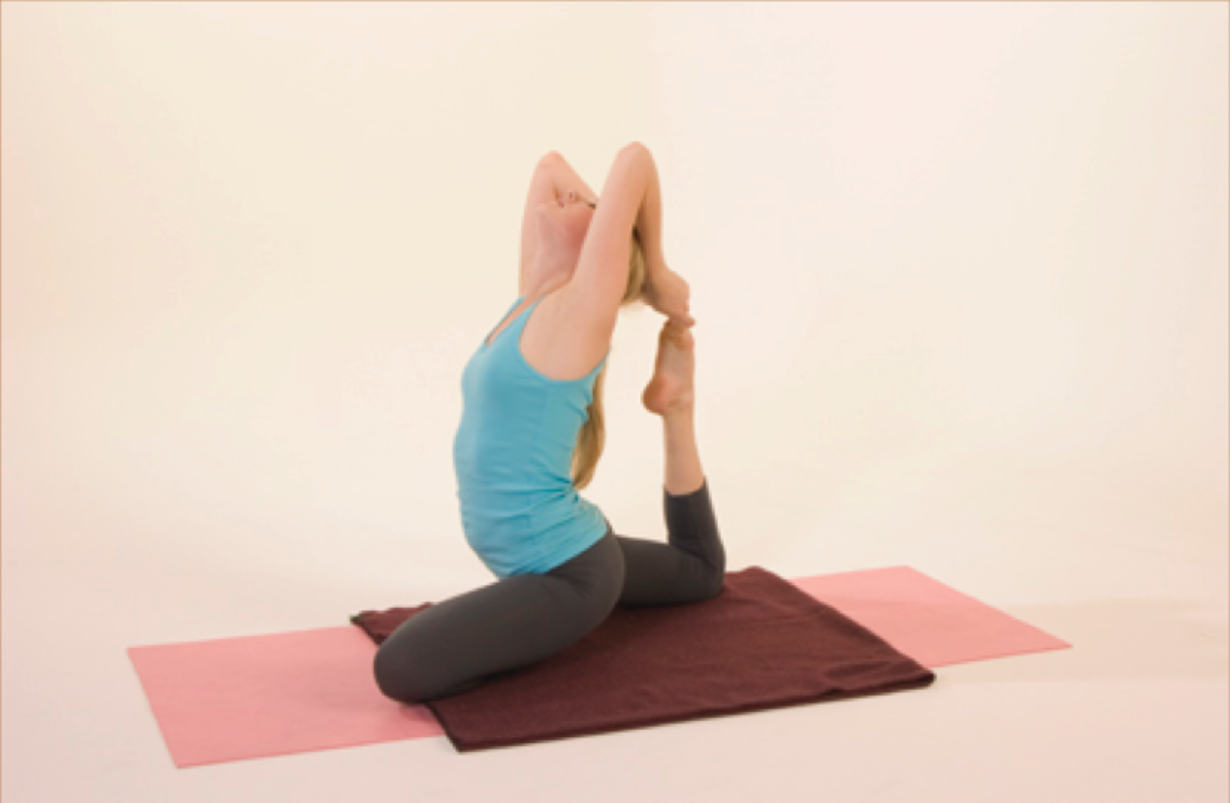
Eka Pada Rajakapotasana
Contraindicated for
Description
Pronunciation: (EHK-a PHOD-a RHA-ja KAH-pot AHS-uhna)
Translation: “Eka” means one in Sanskrit. “Pada” means foot or leg. “Raja” means a king. “Kapota” means a pigeon or dove. Asana means yoga pose or posture.
Eka Pada Rajakapotasana (One-Legged King Pigeon Pose) takes us on a journey into deep backbends. Moving into the preparation of this pose the simple pigeon deeply works the hips and helps to release tension in this vital region of our bodies. It requires steady balance while curving backward. The pose is named after kapota which is a dove or pigeon with its chest puffed up. The backbend action of the torso also works the shoulders into an open position, helping to open the lungs
Technique:
There is a simpler variation of the complete pose which is still an advanced backbend and also a preparation for the the complete eka pada rajakapotasana pose.
Please do not be in a hurry to perform this pose. Remember that most people are not able to perform the complete pose until they have spent years of practice and study of backbends.
We present first a desciption of this simpler preparatory variation of Eka Pada Rajakapotasana. As described below this should be practiced in conjunction with variations and other asanas to open your hips and prepare your backbending for the complete pose.
Start by assuming a kneeling position while sitting on your heels. This pose is Vajrasana, hero’s pose. Extend your left leg back so you are in a half split position. Face your knee toward the floor.
Place your hands on the floor next to the right knee. Inhale and as you exhale lift your head and look to the sky with an extended spine, especially your neck.
Bring your right foot forward so that your right lower leg is perpendicular to your torso. Flex the foot and push up with your palms a bit.
Experiment with how open your groin can be as you bring it towards the floor while keeping the hips square (meaning facing forward.) The left hip should come forward as the right hip moves back in space.
If you hips don’t quite make it to the ground, place a blanket or cushion under the right hip. Be mindful of lifting your chest and bringing the shoulder blades in toward the spine.
To come out of this preparatory pose for Eka Pada Rajakapotasana, extend your right leg next to your left leg in Dandasana (seated staff pose). Keep your legs straight forward and together.
Repeat the pose on the other side.