

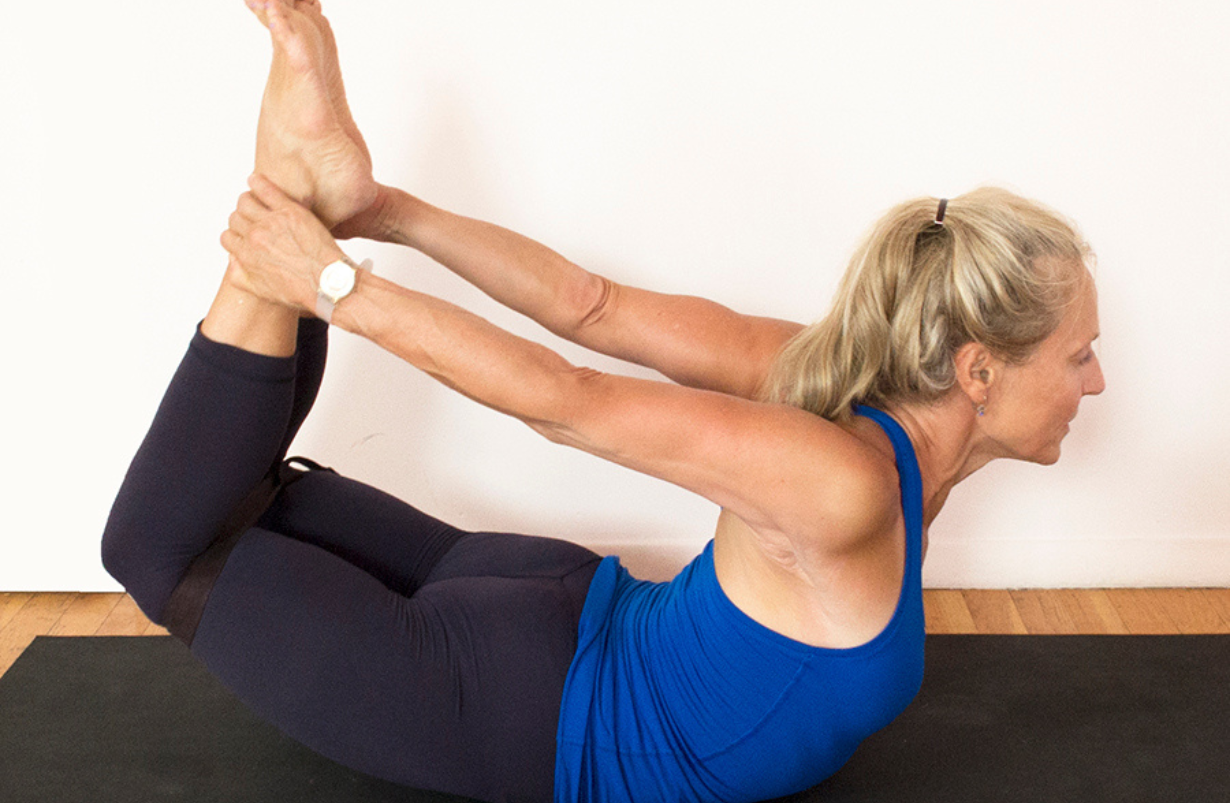
Dhanurasana
Description
Pronunciation: (don-your-AWS-ahna)
Translation: In Sanskrit, Dhanu translates to bow. Asana means pose. The body looks like an archer’s bow. As the spine is toned and made flexible becoming elastic with practice, the abdomen is toned in this posture. With practice, you can bring your feet and arms up quite high. Patricia Walden is doing an inspiring Dhanurasana in the photograph. Her pose represents the fruit of years of dedicated practice. Beginners should not expect to initially achieve this deep a pose. You can grasp the tops of your feet or your ankles as you prefer.
Technique:
Prepare for Dhanurasana by warming up with other backbends such as Urdhva Mukha Svanasana, the upward facing dog pose and Ustrasana, the camel pose.
In Dhanurasana, as in all backbends, it is important to protect your lower back by keeping distance between the vertebrae in your lower spine. This is accomplished by tilting the pelvis by moving the coccyx toward the pubic bone while simultaneously lifting the ribcage up from the pelvis. This action should be maintained throughout the pose. It keeps your lower back long with space between vertebrae and helps prevent back injury.
If you can do Ustrasana with ease while keeping your lower back extended, you are ready to try Dhanurasana.
Place a blanket on the mat to pad hipbones, then lie face down. Bend the knees and grasp the ankles with the hands. Raise your knees up at the same time as you lift your chest up off the floor. Lengthen the spine symmetrically. That means that both the upper back and the lower spine are extended and curved. Open the upper chest and spine by lifting your sternum. Bend evenly so there is not one area that is at an angle, but your whole spine is a “bow” with even spaces between vertebrae without bends. Your neck should be long and extended, not crunched. Make sure your knees aren’t wider than the width of your hips, and keep your knees hip width for the duration of the pose.
As you become more adept at the pose, experiment with bringing your legs together which is more difficult. First bring the inner feet together and then the knees together as you learn the legs together version. When first learning this asana, it is easier to do it with your knees separated somewhat, though the knees are held together in the classical form.
Do not bring the feet inward from the knees. Make back muscles soft and burrow the tailbone through the pelvis toward the floor, which is the same movement to protect the back in backbends that we mentioned above. Yoga master BKS Iyengar says that only the abdomen should bear the weight of the body on the floor in the pose.
After you learn the pose well, you should be able to hold it for eight breaths or so. Breath should be even and flowing in a deep and relaxed way. When you are ready to come out of the pose exhale and bring your knees, chin and shoulders slowly down to the mat. Release your ankles and bring the hands beside the body. Return to a prone position with your legs extended and together, face down on your mat. Either place your forehead on your mat or turn your head to one side for a few breaths.
After Dhanurasana, you might enjoy Balasana, the child’s pose, as a restorative pose. It moves your back muscles in the opposite direction and often feels good after Dhanurasana.
Beginner’s Tip: If you are a beginner, don’t expect your knees or chest to get too high off the ground at first. Work incrementally on lifting them higher off the floor as your stretch gets deeper. If reaching the ankles is a problem, try using a strap around the front of your ankles in the pose, or merely at the start when you are trying to reach them.