

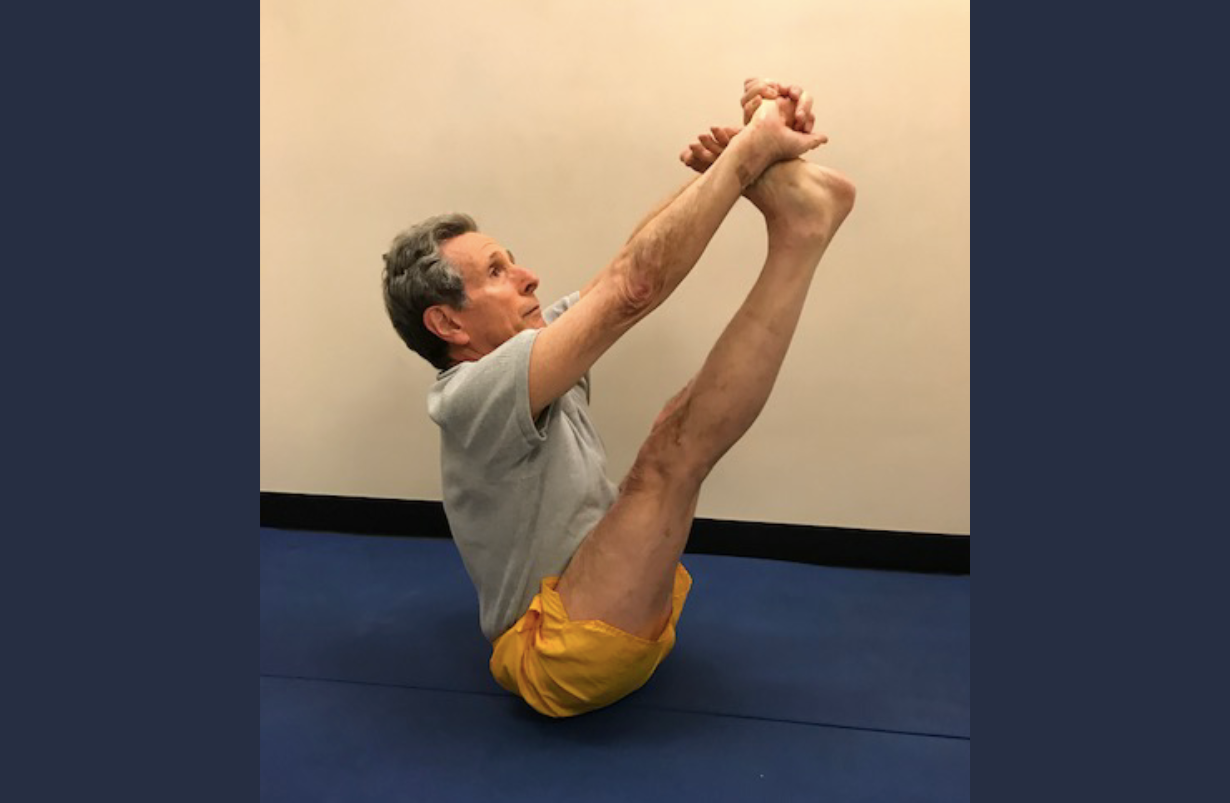
Ubhaya Padangusthasana

Pronunciation: oub-HA-ya pod-awng-goosh-TAWS-ahna
Translation: In Sanskrit, Ubhaya means both. Pada is foot, angustha is the big toe. Asana means pose. Thus Ubhaya Padangusthasana is translated to Both Big Toe Pose. It is a seated posture in which both toes are held while balancing on the buttocks.
Technique: We will describe tw
o ways to assume this pose.
Start sitting on the floor with the legs stretched straight in front of you in Dandasana. Keep your legs together and bend them to bring your knees up so that your feet come close to your torso. Catch hold of your feet or big toes with your hands, exhale and straighten the legs up into the air keeping the balance on your sitbones.
If you do not as yet have adequate stretch to straighten the legs while holding onto your feet, then loop a belt around the soles of the feet and hold onto it with the arms straight and the hands as close to the feet as possible. In the pose keep a straight spine with normal curves. This means that the lower back should be kept slightly concave rather than allowing it to become convex.
If you cannot as yet keep the balance with the straightened legs and straight spine then position a prop such as a blanket roll just behind your pelvis while sitting before assuming
the pose. Then, when you go into the pose, the prop will support your lower back and help you with the balance.
In the pose keep the legs active and the kneecaps pulled up towards your upper legs.
For a more advanced version of the pose bend the arms bringing the elbows out to the side and the active straight legs and chest towards each other while holding the balance on the sitbones. When you eventually bring these together in the balance you will have assumed the Urdhva Mukha Paschimottanasana I pose.
Astangi yogis do this pose as part of the first series which is what you learn as a beginner in that style. It is said to be the most demanding part of Ashtanga Vinyasa Yoga for the first series. As part of a vinyasa flow, ashtanga practitioners move from lying on the back and rolling into Halasana (The Plow Pose). They subsequently roll into the seated balance on the sitbones. Another way to do the posture is to start s
eated as you would in Navasana (The Boat Pose). Develop balance within while strengthening and toning the spine and legs with a hamstring stretch involved.
Begin by lying down on your mat, face up as in Savasana, the corpse pose. Exhale and bring both legs up and over the head to the floor.
Reach your arms back and grasp the big toes. If you cannot reach the toes, try grasping your ankles or the back of calves. Alternatively, use a strap to extend your reach. Keep your head centered. Your arms are "bow strings"creating tension to help you lift up. Inhale as you roll up. The chin is tucked as you roll on a rounded spine. Initiate the roll by leading with your navel.
The tricky part is learning to stop at the balance point having enough momentum to make it up but not so much that you "crash". It helps to exhale at the exact moment that you come up and hit the balance point.
Once
you are up on your sitbones, straighten your arms, extend the legs, bring your head back and look up. You may need to bend your legs. Ashtanga yoga practice includes holding the mula and uddiyana bandhas (locks) which stabilize the pose. The mula bandha, or root lock, is performed by tightening the muscles around the perineal area. The udiyana bandha, often described as bringing the navel to the base of the spine, is a contraction of the muscles of the lower abdominal area. Gaze a drishti point of focus at the third eye (between the eyebrows) once you have the balance. Hold the pose for five long breaths with ease and equinamity.
Beginners Tip:
A yoga practitioner says that she was taught to keep her arms straight when she reached the final position. She advises that one should be sure to do correct dristi. Doing these two things helped her to do the pose beautifully with an extended, straight spine.