

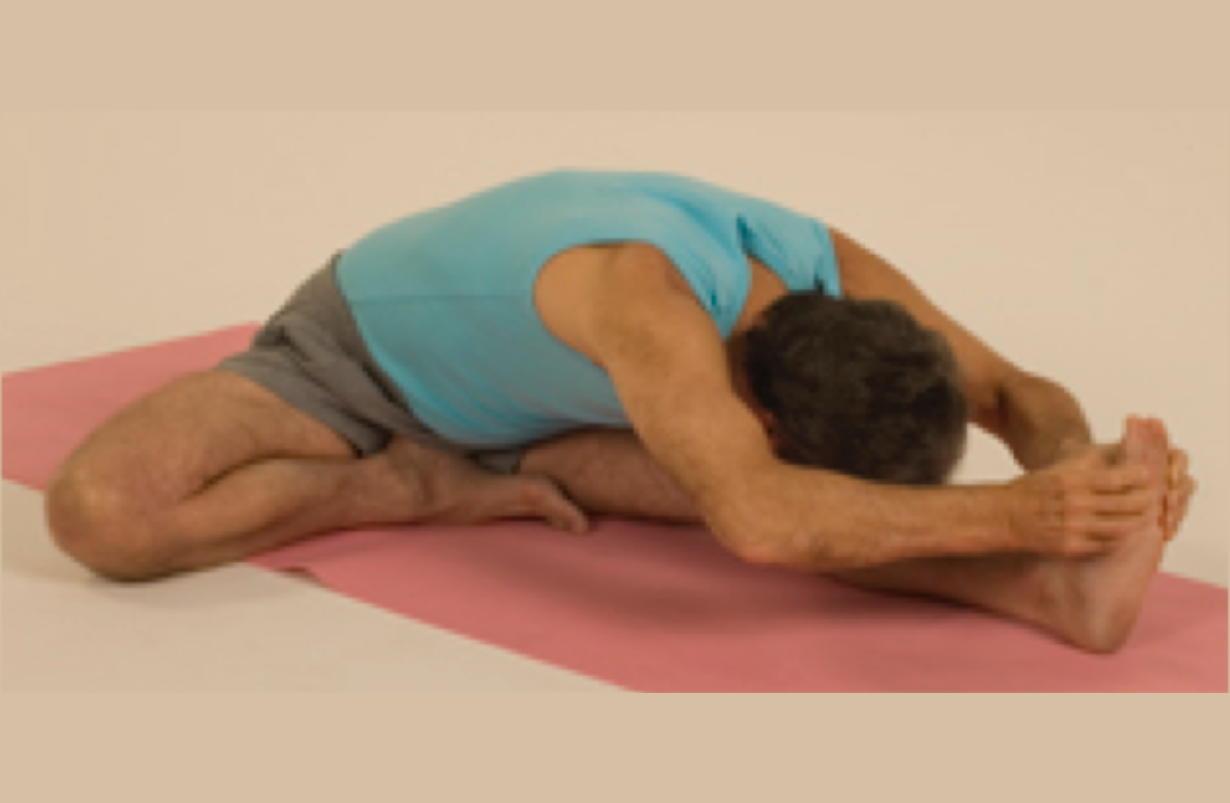
Janusirsasana
Contraindicated for
Description
Pronunciation:
Janu Sirsasana (Head-to-Knee Pose). The Sankrit name is pronounced JAH-noo sheer-SHAHWS-anna.
Translation:
Janu means knee and sirsa means the head. Asana means pose in Sanskrit.
A forward bend for all levels of students, Janu Sirsasana is also a spinal twist. It is a pose to enjoy asymmetry. The potential is to free up constriction in different parts of the back and to loosen t he hamstrings.
Technique:
Spread a blanket over a sticky mat. Sit with the pelvis perpendicular to the floor and the spine extended. Extend the legs forward in Dandasana, the staff pose. Bend the left knee bringing the thigh and calf close to each other. The ball of the left foot touches the inside of the right thigh. Place your heel on the left upper thigh near your perineum. Beginners can make the pose easier by placing their whole sole beside the right upper thigh. Relax your leg and groin as you pull the knee back, aiming at keeping the bent knee on the floor. It may come up an inch off the floor and that is okay. You will want to decrease the width of the angle if the knee is coming up higher than one inch. If there is pain or injury in your bent knee, use folded blankets under it to support the knee. The same applies if your knee comes off the floor too high (2 inches or more). The leg on the bent knee side should have the outer thigh rolling out and down to the floor.
Extend and stretch the right leg keep the right foot extended with the toes facing towards the ceiling. Initially position the extended right leg a bit to the right from a right angle. This will bring the head of the right femur more deeply into the right hip socket. Then slowly bring the leg back so that it is perpendicular to the pelvis. Keep the right femur as deeply seated into the right hip socket as possible. This action helps reduce the “bulge” that often occurs on the left (bent leg) side of the upper spine during the forward bend.
Turn your rear thigh outward and then lengthen out from your groin through the knee. Turn your right straight leg slightly inward to make sure that your knee faces the ceiling. The quadriceps muscle of the extended right leg is pulling its kneecap up toward the groin. Keep that right upper thigh contracted and the foot act ive during the pose. Lengthen the right leg’s calf muscle to the heel, the hamstrings towards the buttock and “ground” the leg to the floor.
A subtle point is in the activation of the flexed foot on the extended leg. The outer edge of that foot may tend to stretch forward more than the inner edge. To correct this, have equal extension on the inside and outside of the foot. Extend the inside of your forward leg all the way from the groin to the inner edge of the heel and big toe mound of the extended leg’s foot.
At this point, you may want to hurry and move your upper body down toward the forward leg. Take your torso up and draw your sternum upward to the ceiling, shoulders down and the chest open. Keeping this distance between your sternum and your pubic bone extend your spine. This lengthening is critical for the pose.
Now clasp the foot of the extended right leg with the left hand. If you can not reach the foot loop a strap or b elt around the right foot and hold it with the left hand as close to the foot as possible. Bring the right hand to the floor outside your right hip. Push that hand up on the floor and twist the torso toward the straight leg to square the body and face it fully centered over the leg. Extend the spine and use both of hands to rotate the trunk so that the spine has equal extension on both sides with the navel rotating over the medial plane of the extended right leg. Hold this alignment as you clasp the foot or belt with the right hand. Continue extending the spine as you descend to or towards the extended right leg.
In the pose strive for a straight extended spine and flat back with no bulge on the bent leg side of the spine. Getting grounded-ness in your pelvis and bringing the pelvic rim forward instead of having the lower back and pelvis be rounded backward will help you do this. You should feel the femur of the bent left leg moving backwards as the left frontal hip bone moves forward.