

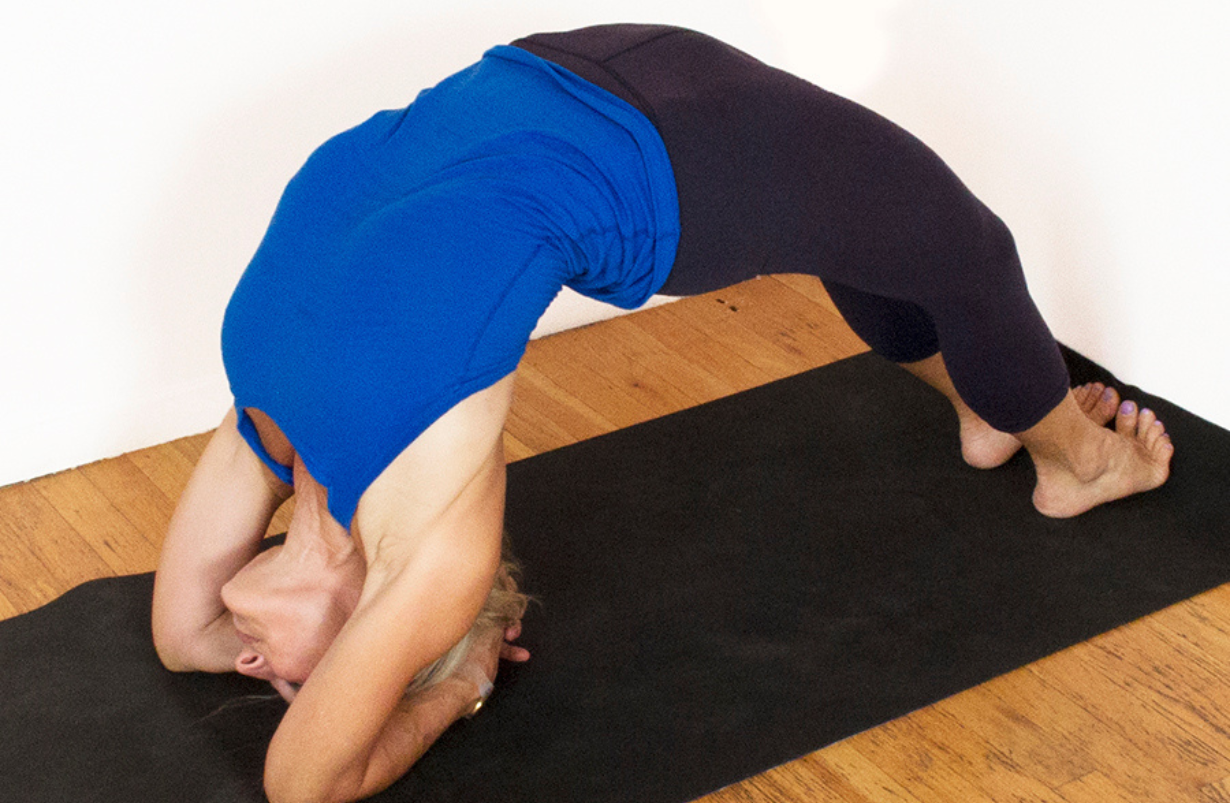
Dwi Pada Viparita Dandasana
Contraindicated for
Description
Pronunciation: DWEE PAW-duh VEE-puh-ree-tuh DAWN-DAWS-uh-nuh
Translation: DWI means two, and Pada means foot in Sanskrit. Viparita translates to mean reversed or inverted. Danda is a staff, and asana means pose or postur
e as in yoga.
Backbends create flexibility in the spine and a flexible spine is correlated with longevity by yogis and others. This is a super pose for opening the heart and making the spine fluid and not a beginning pose yet not too advanced.
Dwi Pada Dandasana has the head is nestled in the hands as they are in Sirsasana (the headstand), and the torso is gracefully arched into the air. Both feet remain on the floor. Eka Pada Viparita Dandasana a more advanced variation Dwi Pada Viparita Dandasana, in which one foot is lifted in the air. Learn the two legged pose first, then move to the one legged version. Practitioners of Iyengar yoga, ashtanga yoga, power and others do this backbend. It can be done against the wall on a mat with the elbows touching the wall, or freestanding in the middle of the room. Use the wall when you are first learning how to do the pose.
Technique: Place a mat on the floor perpendicular to the wall. Have about two inches of the end of the mat reaching up the wall. This offers some cushioning to your elbows when they press into the corner where the wall joins the floor.
Start by lying on your back with your head at or near the wall. Bend your legs bringing your knees up in the air. Attempt to bring your feet close enough to your pelvis so that you can reach and clasp your ankles. Position the feet hip-width apart and paralel. Then move the rear feet outwards so that the heels are a small bit further apart than the toes and balls of the feet. This angling of the feet will slightly separate the buttocks and create space for the coccyx to move through in the pose and protect the low back. After positioning the feet in
this fashion plant them firmly on your mat and keep them firmly planted throughout the pose.
To start moving into the back arch you must raise the pelvis up from the floor. There are a number of areas that are important to attend to as you move your pelvis up.
– A primary danger in backbending is “crunching” your lower back allowing the lumbar vertebrae to collapse towards each other and put pressure on the cartilage between them. For some, over time, this movement can lead to pain and eventually lower back injury. To avoid this collapse keep as much space as possible between the vertebrae in your lower back as you work in this pose. As you move your pelvis up, keep it tilted and continually move the coccyx bone “up and through” your buttocks. Keep this action throughout your work in the pose. This is a sustained pelvic tilt.
- As you move into the pose and while holding it, avoid the tendency to separate the knees. Keep them hip-width apart and don’t let them splay.
- Roll the inner thighs down and the outer thighs up throughout.
- While raising your pelvis, keep all of the above points in mind, and move it forwards toward your feet as well as up.
After you’ve formed a bit of a back arch, place your hands on the mat behind your shoulders and lift your head and shoulders off the ground high enough so that you can position your head as you would in Sirsasana, the headstand. Lower the head keeping your weight on the flat area at the top of your head, the fontanel. Do this carefully with attention to your neck. Clasp your hands behind your head and bring your elbows forward until they are shoulder width apart and face the wall. Eventually the pose can be done without using the wall as a prop. However, initially using the wall is very helpful. To use the wall properly the elbows should be positioned in the corner where the wall meets the floor. If they do not easily reach that spot you should lower yourself out of the pose, adjust the distance your head is from the wall, and try again until you find the proper starting location for you
r body.
Just as you are rolling in with your inner thighs you should also roll down with your inner forearms. Press down with your inner forearms, open your upper chest and move it towards the wall. Walk your legs in towards your head and elevate your pelvis keeping your coccyx moving up between your legs. In the final pose your abdominal area should be flat and your body should form a graceful arch without overarching in the pelvic or chest areas. Hold the pose and continue to work on opening your spine for at least ten breaths before coming down.
This is Dwi Pada Viparita Dandasana. Take a couple of breaths as you refine your Dwi Pada Viparita Dandasana. You should do this a pose a number of times each time you practice it. Make it a regular part of your backbending practice until it becomes familiar and you grow to understand it.
If you are working on the Eka Pada Viparita Dandasana variation lift up your right leg and bend it at the knee. Bring the knee towards your chest and then extend the leg straight overhead. Hold this pose for a number of breaths. To come out, bend the leg, lower the knee towrds the chest, and replace the foot onto the floor. Then repeat the Eka Pada Viparita Dandasana variation on the left side.
When you are finished doing the pose, release your arms, and lower down onto the mat in a lying down position where you can rest. You will notice how stillness
of mind is cultivated in this pose as you are called to be equanimous in doing this challenging and exhilarating backbend.
Beginner’s Tip: Don’t do this pose before you have an established beginning backbending practice. Initially, focus on other backbends like Ustrasana (the Camel Pose), Setu Bandha Sarvangasana over a prop, supported backbends over bolsters or even a blanket roll beneath your shoulder blades on the mat, and Cobra.
We suggest having a teacher instruct you if possible. Those newer to yoga and less flexible can learn to do the two legged version over a chair, with your feet on the wall, a blanket folded under your back and a yoga strap around your thighs. Have a teacher show you how. A teacher who teaches the Iyengar style of yoga is most likely to be familiar with variations and prop use.