Open the Window Through Your Practice Into Your True Nature – Amy Weintraub
Your practice opens a window through whatever mood is visiting. Keep opening that window wider by practicing every day. ~ Amy Weintraub
During the Pandemic, many conflicting emotions arise, as I imagine they have for you. I am grateful to be well, to be living with my partner in peace and in love, and to be learning new technologies in order to offer free online webinars and practices during this time. I’m a slow learner, and I’m crawling like a baby up the learning curve, whining as I go!
Throughout it all, there have been moments of sadness, as I read the stories of individuals who have succumbed, or about others who have unwittingly spread the virus by hugging a relative at a funeral or praying in a church while on vacation. Anger arises toward elected leaders who make policy based on fraudulent self-aggrandizing claims. Joy arises as I celebrate the birth of my new grandson, sadly without my presence by my daughter’s side. Facebook calls are fun, but they don’t meet the need to hold my precious granddaughters.
So how do we and you ride these waves of turbulent emotions? I have two ways.
1. Acknowledge your emotions with compassion.
My first practice is to acknowledge whatever emotion is visiting, welcoming it into my awareness with as much compassion as I can muster. As soon as I do that, I’m not overwhelmed by what is arising, but instead witnessing it.
Last night, worry woke me out of my sleep. I was up and ruminating for quite a while, until I placed my hand on my heart and welcomed worry as though it were a little child. I told my worried child that it was normal to feel this way. I also told that little worrier that the burden she was carrying wasn’t helping her and was depriving me of a good night’s sleep. She must have relaxed knowing I had listened, because the next thing I remember is waking this morning with my hand still on my heart.
2. Commit to your yoga practice.
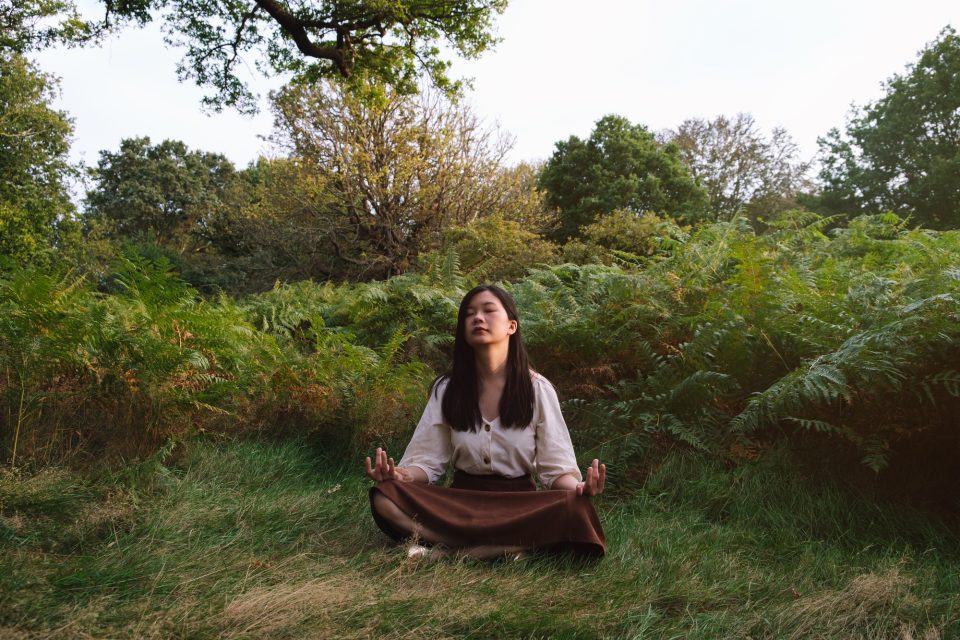
The second practice is my yoga practice itself. The more yoga and meditation I do, the better I feel. I like to practice in nature, and as spring spreads its blanket of blooms around us, there are opportunities for most of us to walk outside or ride a bike, keeping our social distance.
Here’s what my personal practice is like:
Around 6 am, I’m on my mat, loosening stiff joints and stretching so I can sit comfortably in meditation. Sometimes this includes a full asana flow, and sometimes not. I resist the impulse to check my phone for headlines. Most mornings I tell myself the news will be there when I’m finished, and I’m often successful in avoiding it for an hour or two, though not always.
Once I’m seated for meditation, I practice pranayama breathing, chant Sanskrit mantras, and meditate for about 30 minutes. Am I meditating the whole time? Some of the time, yes. Other times, I’m thinking. If a thought turns into worry, I consciously turn it into prayer and return to my mantra.
Later in the day, I ride my bike up a small mountain near downtown Tucson. At the top, I do poses starting with standing kriya breathing and then slower breathing focused on extending my exhalations. I move through moon salutations, sun salutations, and balancing poses, all while wearing a mask.
Now that I’ve outlined my routine, I realize it’s the same practice I followed before the Pandemic and will likely continue after it’s over. Research shows that **yoga is “dose dependent”**—the more we practice, the more we improve brain function and even enlarge areas of the brain that help manage emotions.
With compassion for all that’s arising, the invitation is to open that window through your practice into your own true nature, unsullied by whatever has happened to you; the place where you are deeply and intimately connected, beyond story, beyond mood, and especially beyond this virus.
Amy Weintraub, MFA, E-RYT 500, YACEP, C-IAYT, is the founder of LifeForce Yoga, the author of Yoga for Depression (Broadway Books) and Yoga Skills for Therapists (W.W. Norton), and numerous articles and book chapters. Her YouTube channel offers free practices for balancing mood, including the “Remote Relief” series she has posted during the Pandemic. Her new novel, TEMPLE DANCER, is available for pre-order now at www.amyweintraub.com.


Open the Window Through Your Practice Into Your True Nature – Amy Weintraub
Open the Window Through Your Practice Into Your True Nature – Amy Weintraub
Your practice opens a window through whatever mood is visiting. Keep opening that window wider by practicing every day. ~ Amy Weintraub
During the Pandemic, many conflicting emotions arise, as I imagine they have for you. I am grateful to be well, to be living with my partner in peace and in love, and to be learning new technologies in order to offer free online webinars and practices during this time. I’m a slow learner, and I’m crawling like a baby up the learning curve, whining as I go!
Throughout it all, there have been moments of sadness, as I read the stories of individuals who have succumbed, or about others who have unwittingly spread the virus by hugging a relative at a funeral or praying in a church while on vacation. Anger arises toward elected leaders who make policy based on fraudulent self-aggrandizing claims. Joy arises as I celebrate the birth of my new grandson, sadly without my presence by my daughter’s side. Facebook calls are fun, but they don’t meet the need to hold my precious granddaughters.
So how do we and you ride these waves of turbulent emotions? I have two ways.
1. Acknowledge your emotions with compassion.
My first practice is to acknowledge whatever emotion is visiting, welcoming it into my awareness with as much compassion as I can muster. As soon as I do that, I’m not overwhelmed by what is arising, but instead witnessing it.
Last night, worry woke me out of my sleep. I was up and ruminating for quite a while, until I placed my hand on my heart and welcomed worry as though it were a little child. I told my worried child that it was normal to feel this way. I also told that little worrier that the burden she was carrying wasn’t helping her and was depriving me of a good night’s sleep. She must have relaxed knowing I had listened, because the next thing I remember is waking this morning with my hand still on my heart.
2. Commit to your yoga practice.
The second practice is my yoga practice itself. The more yoga and meditation I do, the better I feel. I like to practice in nature, and as spring spreads its blanket of blooms around us, there are opportunities for most of us to walk outside or ride a bike, keeping our social distance.
Here’s what my personal practice is like:
Around 6 am, I’m on my mat, loosening stiff joints and stretching so I can sit comfortably in meditation. Sometimes this includes a full asana flow, and sometimes not. I resist the impulse to check my phone for headlines. Most mornings I tell myself the news will be there when I’m finished, and I’m often successful in avoiding it for an hour or two, though not always.
Once I’m seated for meditation, I practice pranayama breathing, chant Sanskrit mantras, and meditate for about 30 minutes. Am I meditating the whole time? Some of the time, yes. Other times, I’m thinking. If a thought turns into worry, I consciously turn it into prayer and return to my mantra.
Later in the day, I ride my bike up a small mountain near downtown Tucson. At the top, I do poses starting with standing kriya breathing and then slower breathing focused on extending my exhalations. I move through moon salutations, sun salutations, and balancing poses, all while wearing a mask.
Now that I’ve outlined my routine, I realize it’s the same practice I followed before the Pandemic and will likely continue after it’s over. Research shows that **yoga is “dose dependent”**—the more we practice, the more we improve brain function and even enlarge areas of the brain that help manage emotions.
With compassion for all that’s arising, the invitation is to open that window through your practice into your own true nature, unsullied by whatever has happened to you; the place where you are deeply and intimately connected, beyond story, beyond mood, and especially beyond this virus.
Amy Weintraub, MFA, E-RYT 500, YACEP, C-IAYT, is the founder of LifeForce Yoga, the author of Yoga for Depression (Broadway Books) and Yoga Skills for Therapists (W.W. Norton), and numerous articles and book chapters. Her YouTube channel offers free practices for balancing mood, including the “Remote Relief” series she has posted during the Pandemic. Her new novel, TEMPLE DANCER, is available for pre-order now at www.amyweintraub.com.
More posts